Key takeaways
- IT consulting rates run about $100–$300 an hour in the US and £60–£250 in the UK.
- Seniority moves the price most, so check who's named: senior rates for junior staff are the classic overpay.
- An independent senior often costs half a mid-size firm's rate, minus bench cover and indemnity.
- Nearshore means CEE for UK buyers and Latin America for US buyers, saving 30–60% on long delivery.
- Regulated work under HIPAA, SOX, FCA rules, or UK GDPR adds 15–50%.
- Paid discovery, credited against the project, cuts the final consulting cost more than haggling over IT consulting fees.
All figures in this guide are indicative market ranges as of September 2026. They exclude VAT, sales tax, travel, and expenses, and vary with scope, seniority mix, and contract length.
Two proposals are on your desk, and they make IT consulting rates look random. One quotes $120 an hour, the other $310, and both promise the same assessment. Sterling bids spread just as widely, from £90 to £250 an hour. Neither number is wrong by default. The gap usually comes from who's on the team, how scope is priced, and what's billed on top.
This guide breaks down the cost of IT consulting by seniority, industry, firm size, and country, with every market side by side. It also shows what justifies the gap so that you can tell a fair quote from an inflated one.
IT Consulting Rates at a Glance
In 2026, most mid-market and enterprise companies pay $100–$300 an hour for business IT consulting services in the US and £60–£250 in the UK. Where your quote lands depends less on the country than on who you hire. The table below puts the same five buyer profiles side by side across four markets.
Typical hourly IT consulting rates by buyer profile and market, 2026
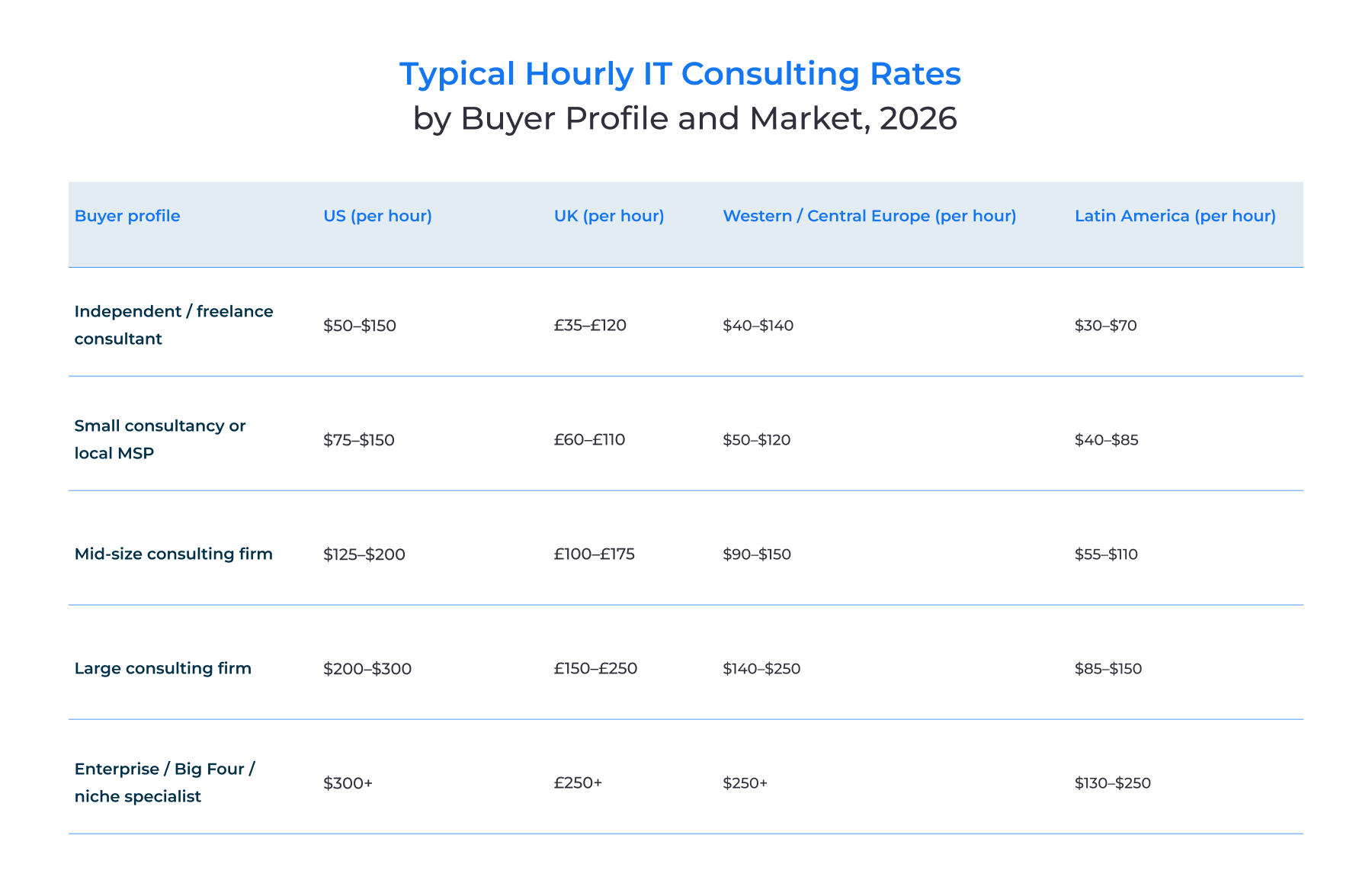
Ranges are indicative market estimates as of September 2026. They combine public pricing data from Clutch's IT services pricing guide, UK contract data from IT Jobs Watch, and US federal ceiling rates from the GSA CALC+ tool. Ranges exclude VAT, sales tax, travel, and expenses. Actual quotes vary with scope, specialization, and contract length.
Latin America is here as the nearshore option for US buyers. Its consultants work your business day, and that overlap is exactly why they cost more than offshore teams in Asia. For UK buyers, the nearshore equivalent is Central and Eastern Europe.
The gap between firm types is far wider than the gap between countries. A Big Four team in London and a two-person consultancy in Leeds both bill in pounds. Their rates can still differ fivefold. Consultancy.uk puts leading strategy firms at £300 or more an hour.
Clutch puts the typical US and Canadian IT services provider at $100–$149 an hour. In the UK, the median contract rate for an IT consultant is £500 a day, or roughly £67 an hour over a 7.5-hour day.
At the top, GovCon API's analysis of GSA schedule rates found one large federal prime's program managers at a median near $252 an hour. The market median sits around $183.
What You Are Actually Paying For
An IT consulting invoice buys judgment. Hours are only the unit it's measured in. The costliest mistake in most technology programs is building the wrong thing. A consultant is paid to lower that risk before the budget is committed. Good business technology consulting often shows its value in the projects you decide not to start.
So before you judge a number, check two things: what kind of provider you're hiring, and what the rate actually covers.
IT consultant vs. software developer vs. managed service provider
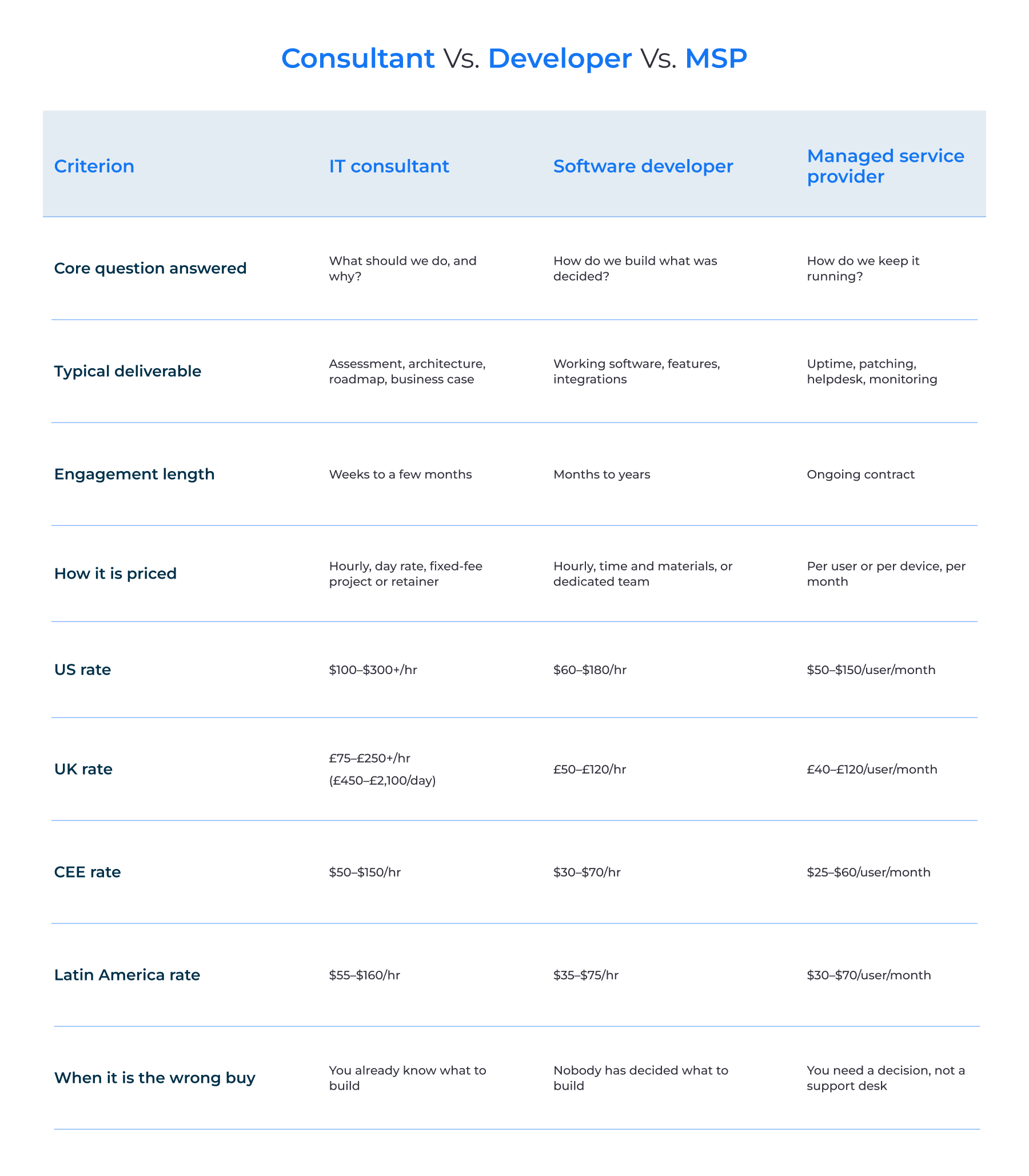
Indicative ranges as of September 2026. UK contract medians from IT Jobs Watch: £600 a day for IT strategy and £525 for software developers. Firm rates run higher than individual contractor rates. MSP pricing reflects Kaseya's global MSP benchmark survey of 1,091 providers.
A developer builds what's specified. A consultant decides what should be specified. An MSP keeps the result running afterward.
That split explains the price gap better than any skills list. Deciding carries more risk than executing, so consulting rates sit above development rates in every market. MSPs price per user because their workload grows with your headcount. When proposals for IT consulting services, development, and managed support land on your desk, compare the question each one answers first. The hourly figure comes second.
What is included in a consulting rate — and what is not
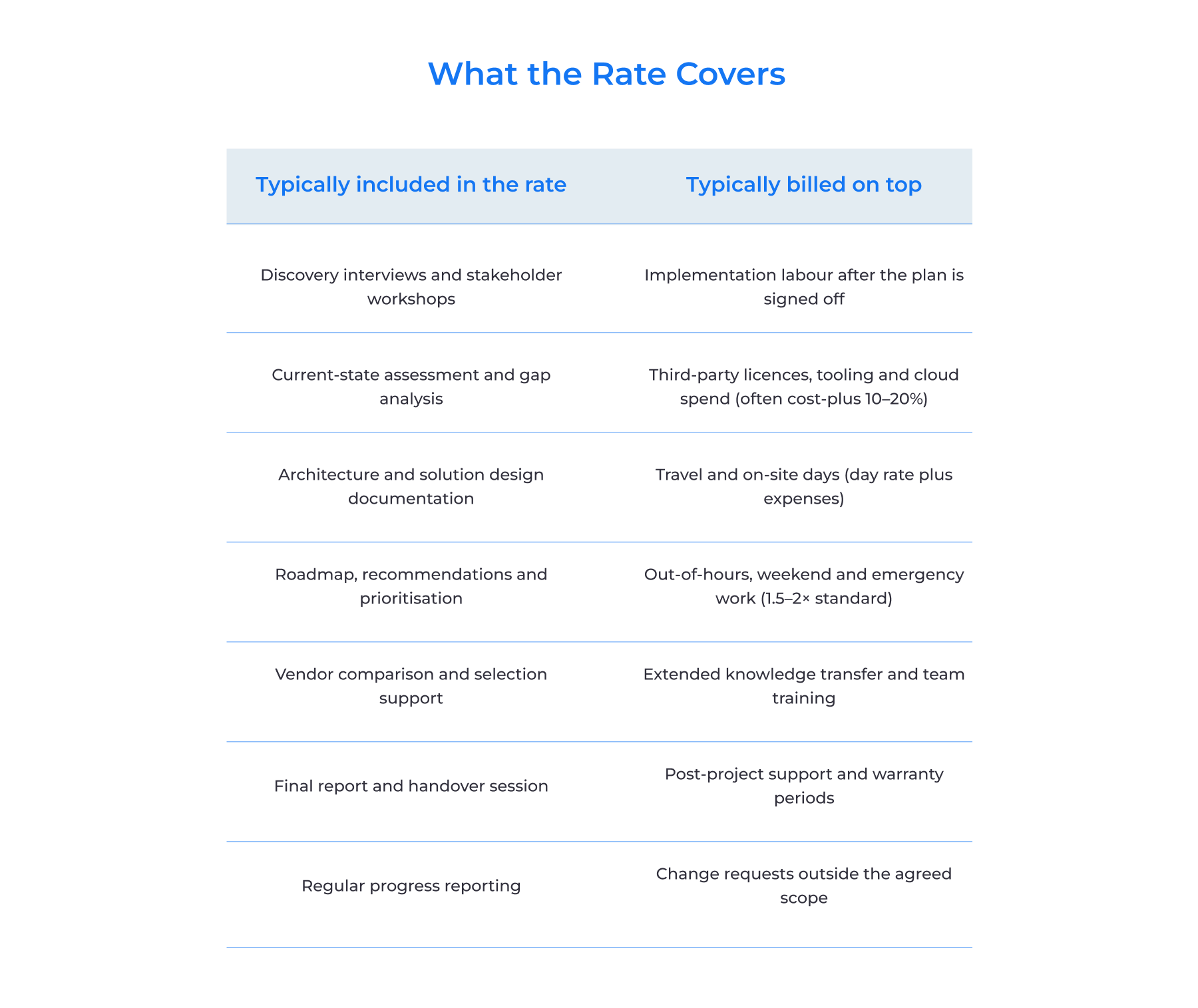
Hold this list against the quote you already have. Anything from the right-hand column that the proposal doesn't mention is a question to ask before signing. Two quotes with the same day rate can end up far apart once travel, license markups, and change requests are counted. Ask each firm to put its markup percentage and out-of-hours multiplier in writing. Surprises on the final invoice rarely come from the rate itself.
IT Consulting Rates by Seniority
Seniority is the variable that most changes an IT consulting invoice. It's also the one proposals blur most often. The table shows what each level typically bills and, more usefully, what it should be accountable for.
Hourly IT consultant rates by seniority and market, 2026
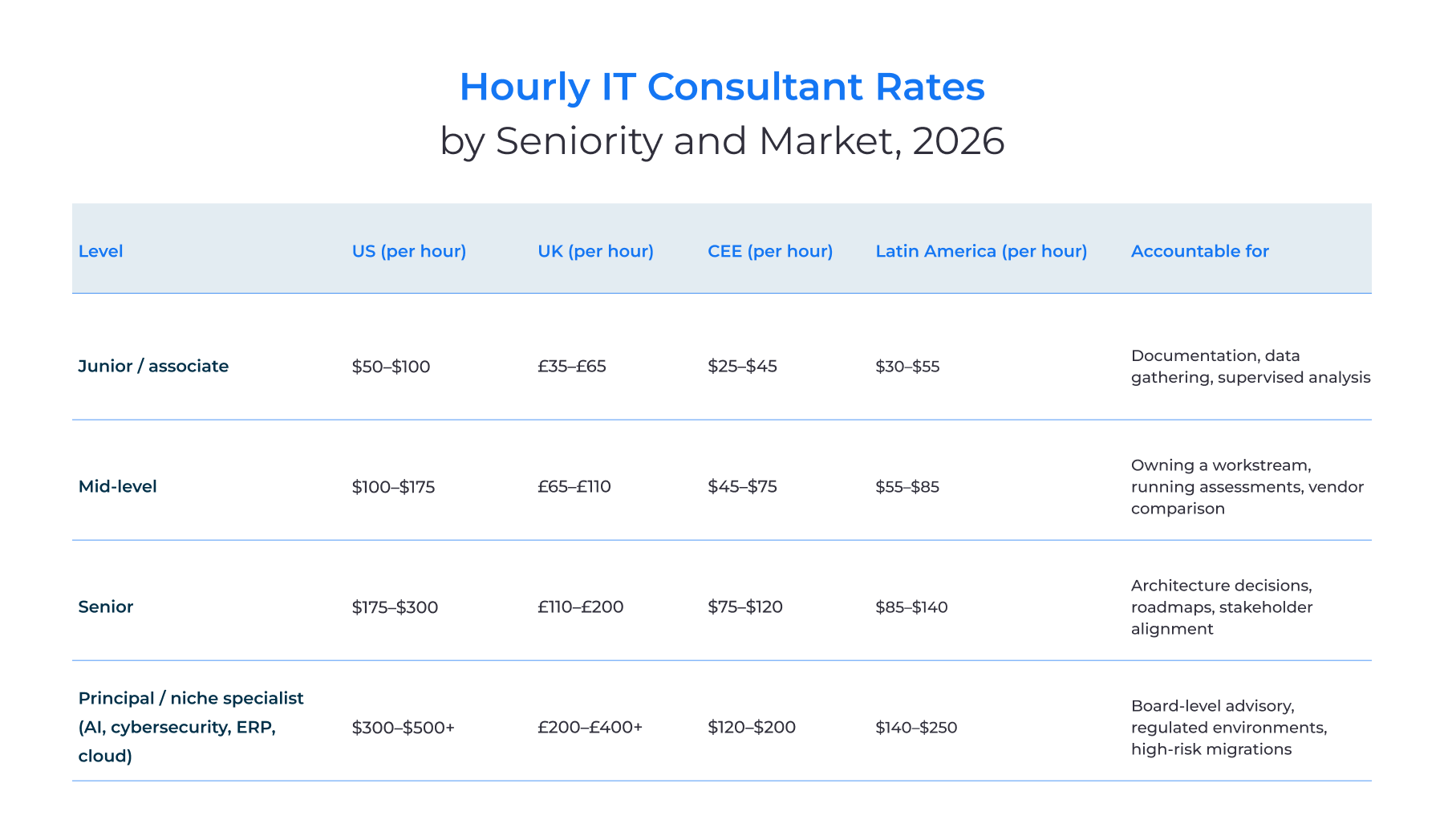
Indicative firm billing rates as of September 2026. Individual UK contractors bill less: IT Jobs Watch puts median day rates at £325 for junior roles, £600 for senior consultants, and £750 for principal consultants.
Latin America is the nearshore column for US buyers. For UK and EU buyers, it's Central and Eastern Europe.
Junior and associate consultants
Juniors gather data, run interviews from a script, and write up what seniors decide. That work matters. It shouldn't be priced like judgment, though. ZipRecruiter puts entry-level US IT consultant pay at about $31 an hour, well below what firms bill for them. The most common way buyers overpay is a proposal priced at senior rates and staffed with juniors. Ask for named people and their levels, then check the timesheets.
Mid-level consultants
Expect $100–$175 an hour in the US and £65–£110 in the UK. A mid-level consultant owns a workstream end to end. Running a current-state assessment, scoring three vendors against your requirements, keeping a migration plan on schedule: that's their territory. They can present findings to your IT leadership without a senior in the room. What they shouldn't do alone is set target architecture or trade off risk against budget. Most engagements lean on this level for the bulk of billable hours. It's where the blended rate is really set.
Senior consultants
Senior consultants bill $175–$300 an hour in the US and £110–£200 in the UK. For most mid-market engagements, this is the level you're actually buying. Seniors make the architecture calls, build the roadmap, and get your CFO and head of engineering to agree on it. They've seen the failure modes before. That experience shortens discovery and cuts rework later. If a proposal lists senior time under 20% of total hours, ask who is making the decisions. A cheaper blended rate often hides a thin senior layer.
Principal consultants and niche specialists
Principals start around $300 an hour in the US and £200 in the UK. This tier covers board-level advisory, regulated environments, and migrations where failure is expensive. The premium sits in four specialisms: AI strategy and implementation, cybersecurity and compliance, ERP programs such as SAP, and cloud architecture at enterprise scale. You rarely need them full time. A few days a month, at the right decision points, is usually enough. An average IT consultant hourly rate tells you little here, because a principal's value shows up in risks that never happen.
Seniority moves consulting rates more than geography does. A senior consultant in London and one in Chicago cost more like each other than either costs next to a junior in their own city. So when two quotes differ sharply, check the staffing mix before blaming the location. Swapping two senior days for four junior days changes a budget faster than moving the work across an ocean.
IT Consulting Rates by Firm Size
Moving up a tier in IT consulting doesn't buy you a smarter consultant. It buys delivery capacity, a tested methodology, indemnity cover, and someone to step in when a person leaves.
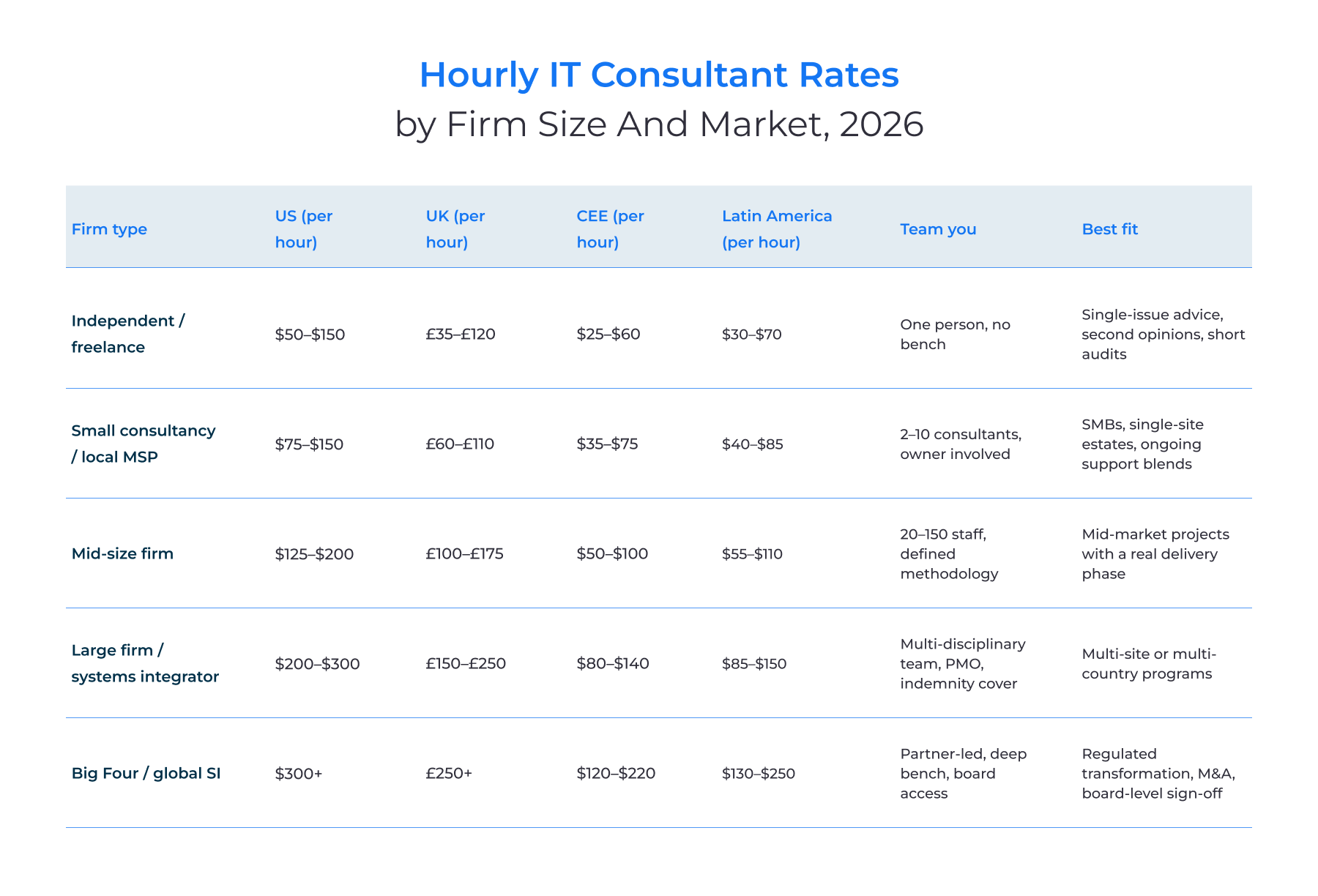
Hourly rates by firm size and market, 2026
Independent and freelance consultants
This is where the US and UK diverge most. Britain has a deep, established IT contractor market, and it's cheap relative to firm rates. IT Jobs Watch puts the median UK IT consultant contract at £500 a day, about £67 an hour. That's well under half of what a mid-size firm bills. For UK buyers, check IR35 status before you sign. It decides who carries the tax risk.
Small consultancies and local MSPs
Small consultancies charge $75–$150 an hour in the US and £60–£110 in the UK. They mix advice with hands-on support. Often the owner is the senior consultant, which means you get real experience at a moderate rate. The catch is capacity. A team of five can't absorb a surprise workload or cover two sick days in the same week. They fit SMBs and single-site estates well, especially when you want strategy and support from the same people.
Mid-size consulting firms
At $125–$200 an hour in the US and £100–£175 in the UK, a 20–150-person firm has a defined method, a bench, and enough seniors to staff a proper delivery phase. You aren't paying for a famous brand. That's the main reason rates sit well below large firms for similar senior talent. This tier suits mid-market projects where the plan and the build need to stay connected.
Large firms and systems integrators
Large firms and integrators bill $200–$300 an hour in the US and £150–£250 in the UK, and what they sell is coordination. You get a program management office, specialists across infrastructure, data, and security, and professional indemnity limits big enough for multi-country programs. For a single-system upgrade, most of it is wasted. For a rollout across 12 countries and three ERP instances, it's the product.
Big Four and global consultancies
At $300 an hour and up in the US, or £250 in the UK, you're paying for a partner's signature as much as the work. Boards, auditors, and regulators often trust these names, which matters in M&A, regulated transformation, or anything needing board sign-off. The bench is deep. Day-to-day work, though, is often done by junior and mid-level staff. Ask how many partner hours are in the plan. Then ask who's on site each week.
An independent senior consultant often knows as much as a mid-size firm's senior and charges about half the rate. That's the honest trade-off. What you give up is continuity and bench cover when they're sick or booked elsewhere. You may also lose indemnity insurance your legal team will accept. For short, well-defined advice, that's usually fine.
IT Consulting Rates by Industry
Industry premiums in IT consulting follow regulation. When a mistake can trigger a fine or an audit finding, consultants charge for the extra rigor. They also carry more liability. US and UK buyers face different rulebooks, so the drivers below name both.
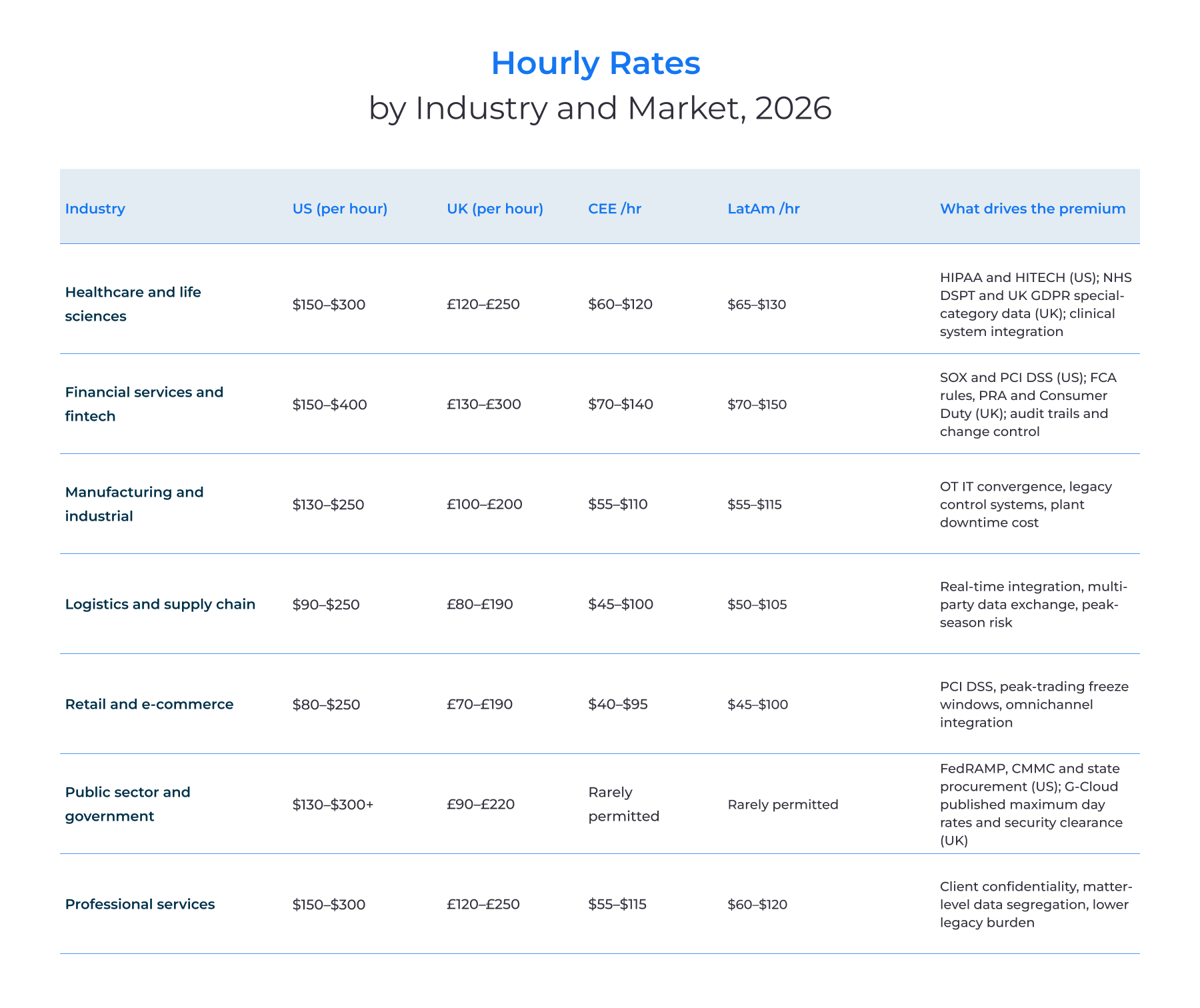
Hourly rates by industry and market, 2026
Healthcare and life sciences
Healthcare work runs $150–$300 an hour in the US and £120–£250 in the UK. Patient data raises the stakes on both sides of the Atlantic. In the US, consultants are required to comply with the HIPAA and HITECH Acts; thus, they risk suffering federal penalties in case of a data breach. At the same time, UK-based companies should apply the NHS Data Security and Protection Toolkit and treat health data as special category information under the UK GDPR. Integrating with clinical systems like EHRs adds testing time. You're paying for people who've done it before.
Financial services and fintech
At $150–$400 an hour in the US and £130–£300 in the UK, this is the widest range in the table, and the top end is real. US firms answer to SOX for financial controls and PCI DSS for card data. In the UK, it's FCA rules, PRA oversight for larger institutions, and the Consumer Duty. Every change needs an audit trail—consultants who can design controls that pass an audit the first time bill accordingly.
Manufacturing and industrial
Manufacturing sits at $130–$250 an hour in the US and £100–£200 in the UK. Here the premium comes from physics, not paperwork. Connecting shop-floor OT to enterprise IT means working around control systems that may be 20 years old. And an hour of stopped production can cost more than the whole consulting engagement. Buyers pay for consultants who plan cutovers around shift patterns and know which systems must never go offline.
Logistics and supply chain
Logistics rates run $90–$250 an hour in the US and £80–£190 in the UK, and they spread widely because the work does. A simple warehouse system upgrade sits near the bottom. Real-time tracking that exchanges data with carriers, customs brokers, and customers sits at the top. Timing adds risk too. Nobody wants a failed integration in November, so senior people are often booked for exactly that window.
Retail and e-commerce
Retail starts lowest, at $80–$250 an hour in the US and £70–£190 in the UK. Much of the work is standard platform integration. PCI DSS applies wherever card payments are handled, in both markets. The price jumps near peak trading. Many retailers freeze changes from November into January. That squeezes projects into shorter windows and pushes demand for senior people up.
Public sector and government
Public sector work bills $130–$300+ an hour in the US and £90–£220 in the UK. US federal work requires FedRAMP for cloud services and CMMC for defense contractors, and many roles need clearance. UK buyers expect NCSC-aligned security, often starting with Cyber Essentials. The UK column is lower for a structural reason. Under G-Cloud rules, each supplier's published SFIA day rates are the maximum it can charge. They can be discounted but not raised. Offshore delivery is rarely allowed.
Professional services
Professional services pay $150–$300 an hour in the US and £120–£250 in the UK, near healthcare levels, for different reasons. Client confidentiality is the main driver. Matter-level data segregation, where one client's files must never touch another's, takes careful design. The upside is a lighter legacy burden than banks or manufacturers carry. That keeps the top of the range from climbing further.
IT Consulting Rates by Country and Region
Location sets the baseline for IT consulting, but time zones decide how usable that rate is. A cheaper hour that lands while your team sleeps costs more in delays than it saves. Here's how the main markets compare for US and UK buyers.
Rates by country and region, 2026
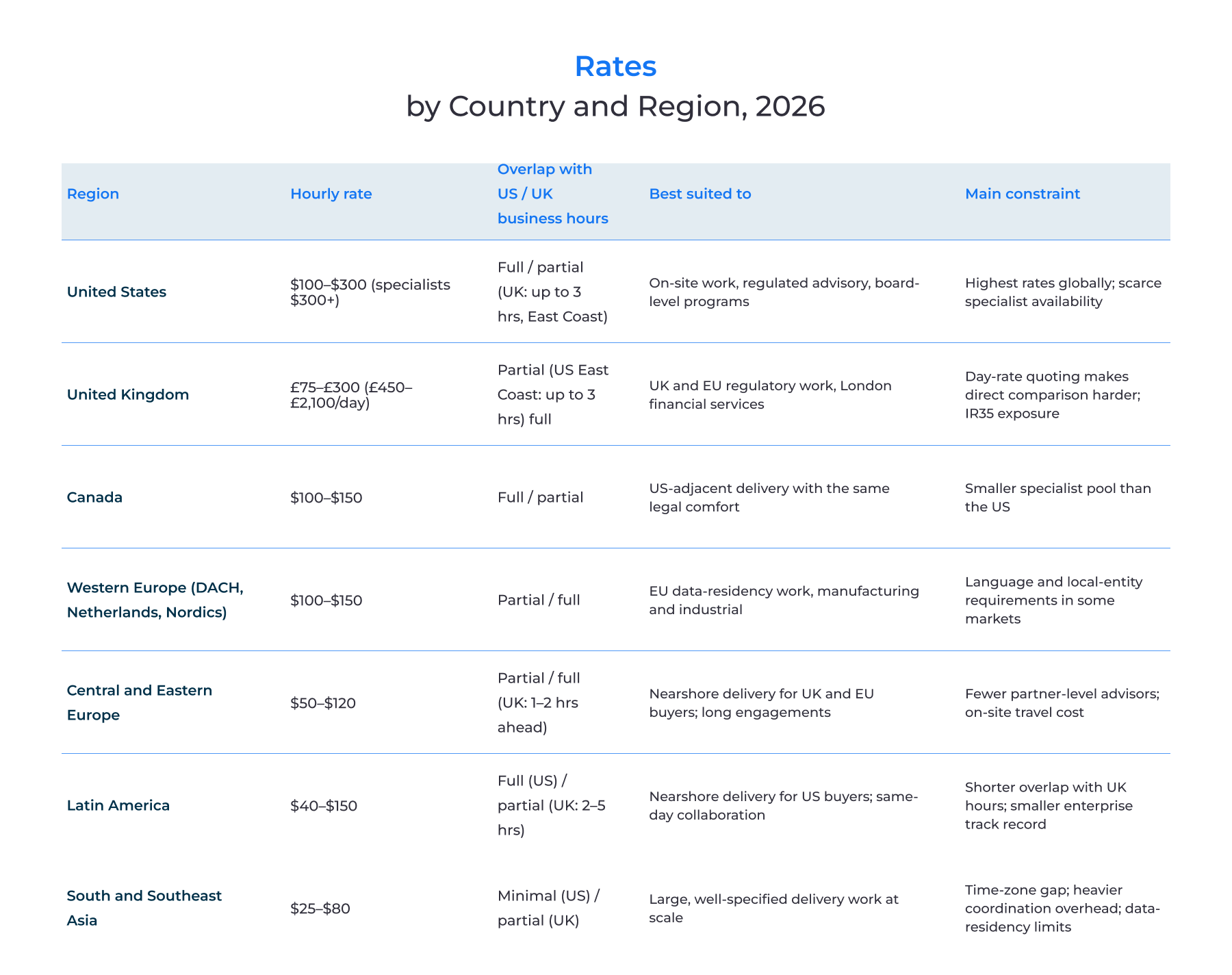
Indicative ranges as of September 2026. Canada and CEE ranges reflect Clutch pricing data. Overlap assumes a 9-to-5 working day.
United States
US rates run $100–$300 an hour, with specialists above that. You're paying for the deepest pool of regulated-industry experience anywhere, plus consultants who can be in your boardroom tomorrow. That suits on-site work, compliance-heavy advisory, and programs that need board visibility. The constraint is price and supply. Senior AI and security specialists are booked months out. And for UK buyers, a West Coast team gives you almost no shared working hours.
United Kingdom
Most UK consultancies quote day rates, not hourly ones. That's the first thing to adjust for. Hourly equivalents run £75–£300, or roughly £560–£2,250 a day over a 7.5-hour day. London firms lead on financial services and UK or EU regulatory work. Two practical risks: a day-rate quote hides how many days are really in scope, and contractor engagements bring IR35 exposure. Ask for a day count per phase before comparing.
Canada
Canadian firms price at roughly $100–$150 an hour. They share US time zones, similar legal frameworks, and familiar contract terms. That makes Canada a comfortable choice for US buyers who want some savings without the risk of offshore delivery. The specialist pool is smaller, though.
Western Europe
DACH, the Netherlands, and the Nordics sit around $100–$150 an hour. That's close to UK levels, so you pick these markets for location, not savings. They suit EU data-residency projects and industrial work. Some clients need a local entity or German-language delivery.
Central and Eastern Europe
At $50–$120 an hour, CEE is the natural nearshore option for UK and EU buyers. Most hubs are one or two hours ahead of London. Teams handle long engagements well. Partner-level advisors are fewer, and on-site visits add travel cost.
Latin America
Latin America runs $40–$150 an hour and shares most or all of the US working day. That's why US buyers pay more here than in Asia. UK overlap is shorter: two to five hours, depending on the country. Enterprise track records vary more from firm to firm.
South and Southeast Asia
Rates of $25–$80 an hour make this region the cheapest option. It works for large delivery programs with a precise specification. Advisory work is harder. The time-zone gap with the US adds coordination cost, and some regulated data can't leave your jurisdiction.
Within-country variation
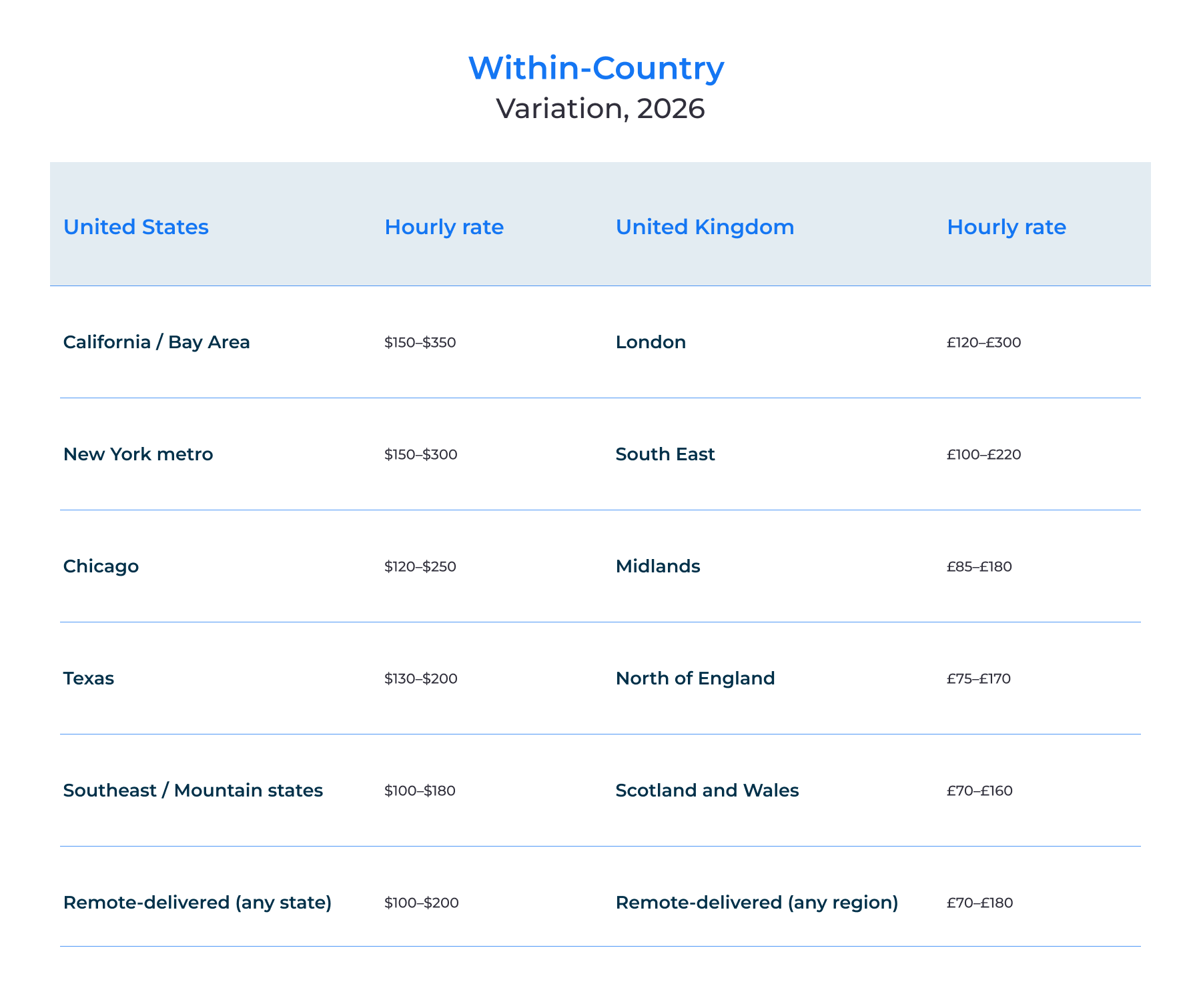
In the US, the spread follows local wage levels. BLS data shows computer and mathematical workers in San Jose earning $97.15 an hour on average, against $57.73 nationally. Firm rates in the Bay Area and New York carry that premium. Texas and the Southeast sit lower.
In the UK, the London premium shows up in firm rates but is fading for contractors. IT Jobs Watch puts the median consultant contract at £550 a day in London and £575 in the North of England. Scotland comes in lower at £453. Remote delivery has narrowed regional gaps for advisory work in both countries. On-site work still costs more in expensive cities.
Within-country variation, 2026
IT Consulting Fee Models and When Each One Works
The same work can cost very different amounts depending on how it's billed. Most consulting firms use a handful of pricing models, and each one moves a different risk onto you or onto the firm.
IT consulting fee models compared, 2026
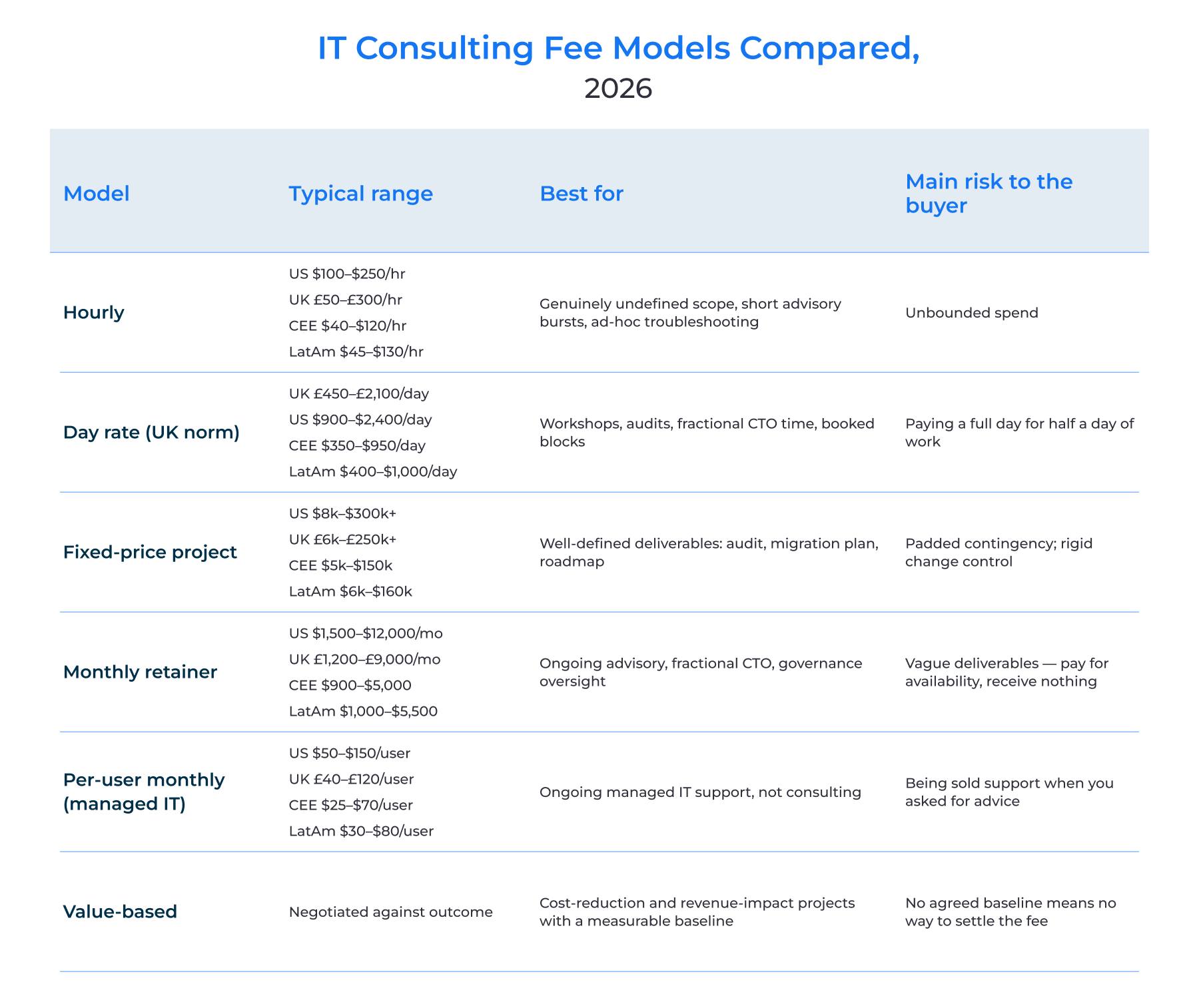
Indicative ranges as of September 2026. Per-user pricing reflects Kaseya's MSP benchmark survey. Project and retainer ranges vary widely with scope.
Hourly billing
Pick hourly when you honestly can't define the scope yet: a first diagnosis, a short advisory burst, or troubleshooting a live problem. It's flexible and fair for small jobs. The failure mode is spending with no ceiling. Set a monthly cap in the contract and ask for weekly hour reports. Without both, hourly consulting fees drift upward quietly.
Day rates — and how to compare them against hourly
Day rates are the UK norm and common for workshops, audits, and fractional CTO time. To compare, divide by the working day in the contract. UK firms usually assume 7.5 hours, US firms 8. So £900 a day is £120 an hour in London terms. The trap is partial days. Agree in writing whether half days exist, or a two-hour call can cost you a full day.
Fixed-price projects
Fixed price suits deliverables you can describe in one paragraph: an infrastructure audit, a migration plan, a technology roadmap. You get budget certainty. The firm prices in a contingency buffer for the risk it takes on, so you pay for uncertainty either way. Change control is the other catch. Anything outside the statement of work becomes a paid change request, so scope carefully before signing.
Monthly retainers
Retainers buy continuity: a fractional CTO, ongoing architecture governance, or a standing advisory line. They work when there's a steady stream of decisions to make. They fail when nobody defines the output. Write the monthly deliverables into the contract, such as a review meeting, a risk register update, or a set number of advisory hours. Otherwise, you're paying for availability, and availability alone doesn't show up anywhere.
Per-user monthly pricing
This is how managed service providers price ongoing support. Per-user or per-device fees cover helpdesk, patching, and monitoring. They're not consulting fees, and that's the point to watch. Some providers bundle a vCIO or "strategic review" into the plan. Check what that means in hours. A quarterly slide deck isn't the same as an architecture decision.
Value-based pricing
Here the fee is tied to results, such as a share of cost savings or a revenue gain. It aligns incentives well on paper. In practice, it only works when both sides agree on a measurable baseline before the work starts. Cloud cost optimization is a good fit, since last year's bill is the baseline. Vague goals like "better agility" don't qualify. Without a baseline, you'll argue about the invoice instead of the outcome.
What IT Consulting Projects Cost
Most budgets get approved per project, not per hour. So here's what common engagements cost end-to-end, in each market, with typical durations.
Typical IT consulting project costs by market, 2026
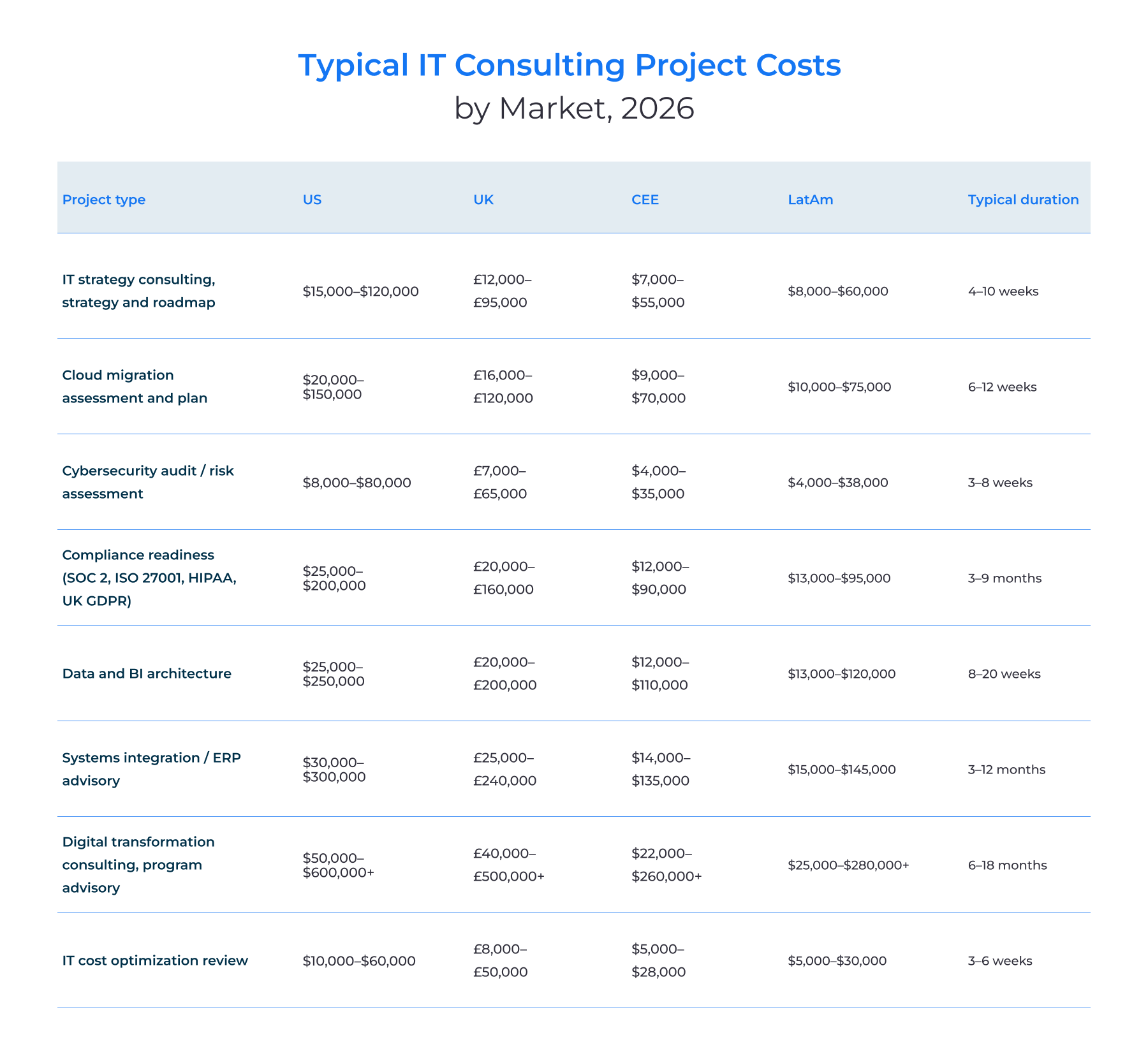
Indicative ranges for advisory scope as of September 2026. Implementation work is usually priced separately.
The spread inside each row is wide on purpose. A roadmap for one business unit and a roadmap for a group with 14 subsidiaries share a name and little else. For reference, Clutch reports that most IT services projects on its platform fall between $10,000 and $49,999. The average comes in higher, near $121,000, pulled up by a smaller number of large programs.
The nearshore columns land at roughly 45–50% of US prices. That gap holds only when the work can run remotely. If a project needs weeks of on-site discovery, add travel before you compare.
Four factors push a project toward the top of its range.
- Integration surface. Every system the consultants need to map, test, or connect adds days. An ERP advisory project touching finance, warehouse, and CRM costs far more than one touching finance alone. Count the interfaces before you ask for a quote.
- Number of sites. Multi-site and multi-country work adds interviews, travel, and local variations to reconcile. Three plants on two continents rarely cost just three times one plant. They cost more, because the differences between sites become the real work.
- Data migration volume. Moving 200 GB of clean records is a planning exercise. Moving 40 TB from systems with duplicate customer IDs is a project in itself. Data quality, not raw volume, usually drives the extra weeks. Ask for a data profiling step early. It's cheaper than finding problems in month three.
- Regulatory sign-off. Compliance readiness takes months because auditors and regulators work on their own calendar. Evidence gathering, remediation, and review cycles all stretch the timeline. Plan for at least one remediation round before the formal audit.
Digital transformation consulting sits at the far end for all four reasons at once. If your advisory scope is likely to turn into delivery, ask how the firm prices the next phase. Some bundle strategy with digital transformation services under one contract. Others restart the pricing conversation, and that's where a fair IT consulting cost can quietly double.
What Drives IT Consulting Rates
Eight factors explain most of the gap between two IT consulting quotes for the same work. The table gives the approximate effect of each. The sections below show how to spot them in a proposal.
Rate drivers and their approximate effect
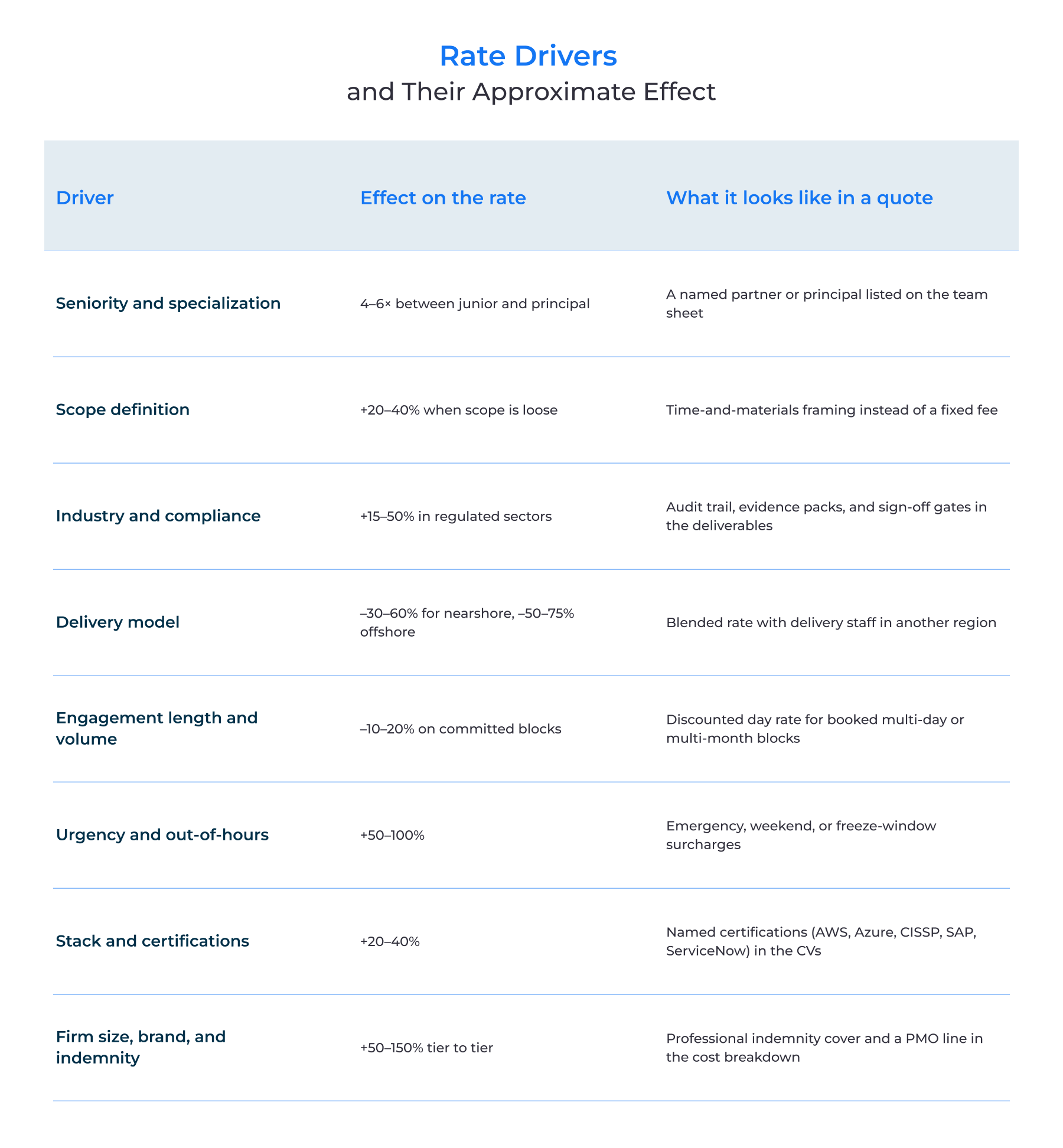
Approximate effects based on the rate ranges in this guide, as of September 2026. They overlap and don't add up in a straight line.
Seniority and depth of specialization
Nothing moves the hourly figure more. In most markets, a principal bills four to six times what a junior does. Independent contractors show a narrower gap: in the UK, IT Jobs Watch puts principal consultants at £750 a day against £325 for junior roles. Depth adds to that. A generalist architect and an architect who has shipped three SAP S/4HANA migrations aren't the same purchase. Check the team sheet for named people, not job titles.
Project complexity and how well scope is defined
Loose scope costs money twice. First, firms add a buffer to cover what they can't see, often 20–40%. Second, they shift to time and materials, which moves the overrun risk to you. You can cut both by paying for a short discovery phase first. Two to four weeks of structured assessment turns an open question into a fixed deliverable. After that, a fixed fee becomes possible. It's usually lower than the padded quote you'd get today.
Industry and compliance requirements
Regulated work takes longer and carries liability. Healthcare, financial services, and government projects need audit trails, documented evidence, and formal sign-off at each gate. Consultants price that in at roughly 15–50% above standard work. The premium is fair when the evidence packs are real deliverables. It isn't when the proposal names a regulation but lists no controls, tests, or documents tied to it. Ask to see a sample evidence pack from a past engagement.
Location and delivery model (on-site, hybrid, remote, offshore)
Where the work happens changes cost more than where the firm is registered. Nearshore delivery typically cuts rates by 30–60%, offshore by 50–75%. Many firms quote a blended rate, with a senior lead onshore and delivery staff elsewhere. That can be good value. It can also hide who does the work. Ask for the rate and location of each person, and for how many on-site days are in the plan. Travel isn't in the day rate.
Engagement length and volume commitment
Commitment lowers consulting rates. Firms can plan staffing around a booked block, so they'll often cut 10–20% for a guaranteed run of days or months. A three-month retainer at a fixed number of days per week usually prices below the same days bought one at a time. The catch is flexibility. If priorities shift halfway through, unused days may still be billable. Read the cancellation and rollover terms before you sign for volume.
Urgency, after-hours and emergency work
Urgency is the easiest premium to avoid. Weekend, overnight, and emergency work typically bills at 1.5 to 2 times the standard rate. Retail freeze windows and financial year-end cutovers add their own surcharges. Some of this can't be planned around. A production outage is an outage. But a migration scheduled for a bank holiday weekend because nobody booked it earlier is a planning cost. Check which surcharges apply before the calendar gets tight.
Technology stack and certifications (AWS, Azure, CISSP, SAP, ServiceNow)
Scarce skills cost more, and certifications are how firms signal them. AWS and Azure architecture certifications, CISSP for security, and SAP or ServiceNow credentials can add 20–40% to a rate. They matter most when your platform choice is already made. A certificate proves someone passed an exam, not that they delivered a project like yours. Ask for one reference from a client running the same platform at a similar scale.
Firm size, brand and indemnity cover
Each tier up the firm-size ladder adds roughly 50–150% to the rate. Part of that pays for real protection: higher professional indemnity limits, a PMO, and a bench that covers absences. Part of it pays for the brand. Your board or auditors may value that, especially in M&A or regulated work. For a contained technical question, you're likely paying for insurance you'll never claim on.
Onshore vs. Nearshore vs. Offshore: What You Save and What You Give Up
"Nearshore" depends on where you sit. For UK and EU buyers, it means Central and Eastern Europe, one or two hours ahead of London. For US buyers, it means Latin America, working the same day as New York or Chicago. The logic of nearshore IT consulting is the same in both cases. You pay less than onshore, and more than offshore, for hours that overlap with yours.
Delivery model trade-offs
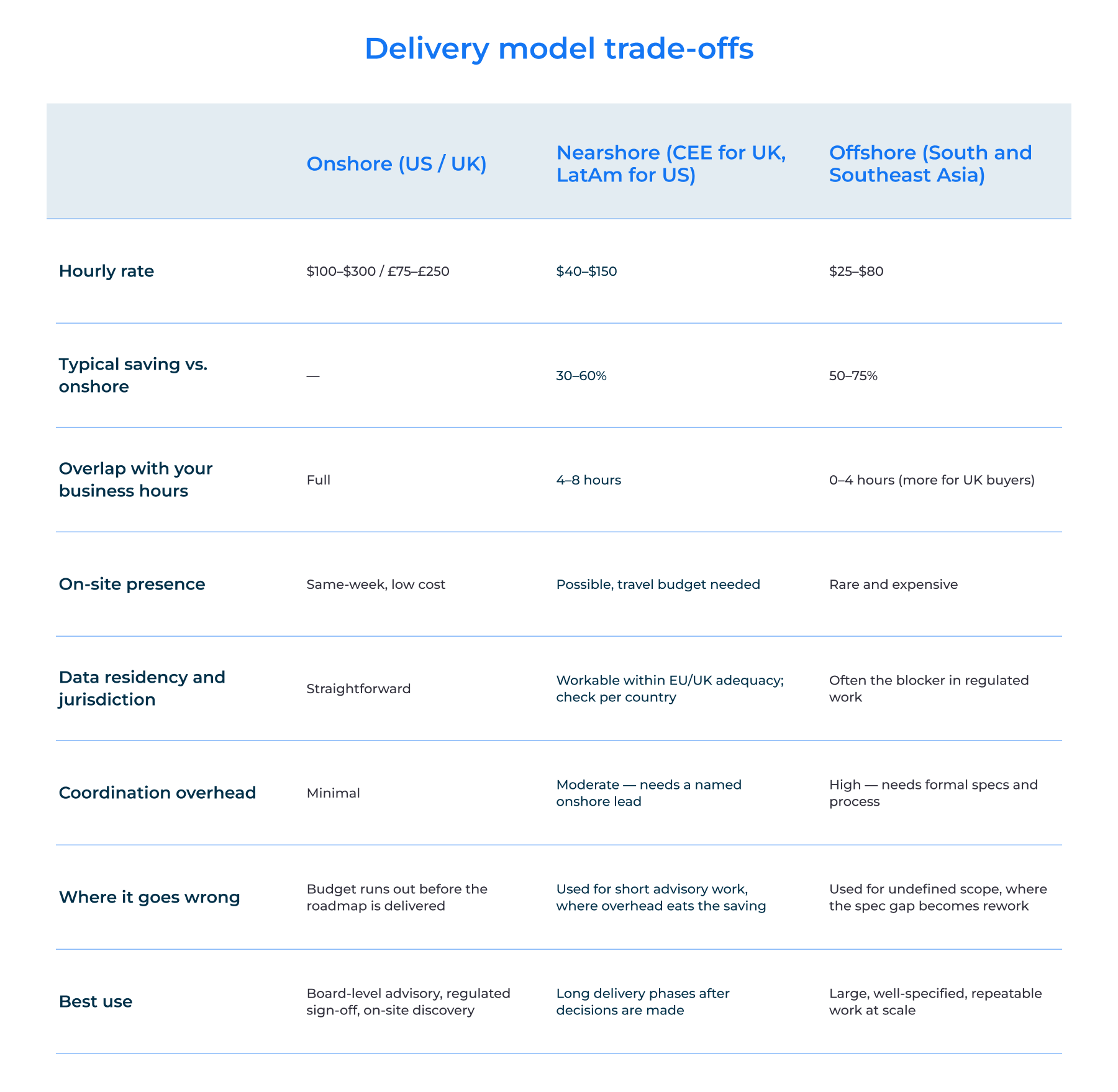
The savings are real, but it isn't automatic. Nearshore consulting rates look 30–60% lower on paper. What reaches your budget depends on how much coordination the work needs and who absorbs it.
Nearshore is the wrong choice in three situations.
- Short advisory engagements. A three-week assessment doesn't leave time to build a working rhythm across two teams. Onboarding, handovers, and extra review calls can eat the whole saving before the final report is due.
- Work that needs constant on-site presence. Discovery on a factory floor, a data center move, or weekly workshops with your executive team all need people in the room. Flights and hotels for a nearshore team quickly erase the rate gap.
- Data that can't leave your jurisdiction. Some regulated data must stay in the UK, the EU, or the US. EU-based CEE countries are generally workable for UK buyers under UK adequacy regulations. Countries outside the EU need their own transfer safeguards. Check before you sign.
Outside those cases, the strongest pattern is a split—senior IT consultants onshore handle discovery, architecture decisions, and stakeholder sign-off. A nearshore team then takes the long delivery phase, where overlap matters more than proximity. That keeps board-level judgment close to you and moves the bulk of billable hours to a lower rate.
Offshore works best one step later, once specs are stable, and the work repeats. Sending it with undefined scope is how a cheap hourly rate turns into an expensive rewrite.
How to Reduce IT Consulting Costs Without Increasing Risk
Cutting the rate and cutting the cost aren't the same thing. A 10% discount on a badly scoped project still overruns. Three of the six levers below reduce your total spend, irrespective of rate, by focusing on value: narrower scope, paid discovery, and in-sourcing simple work.
Cost levers
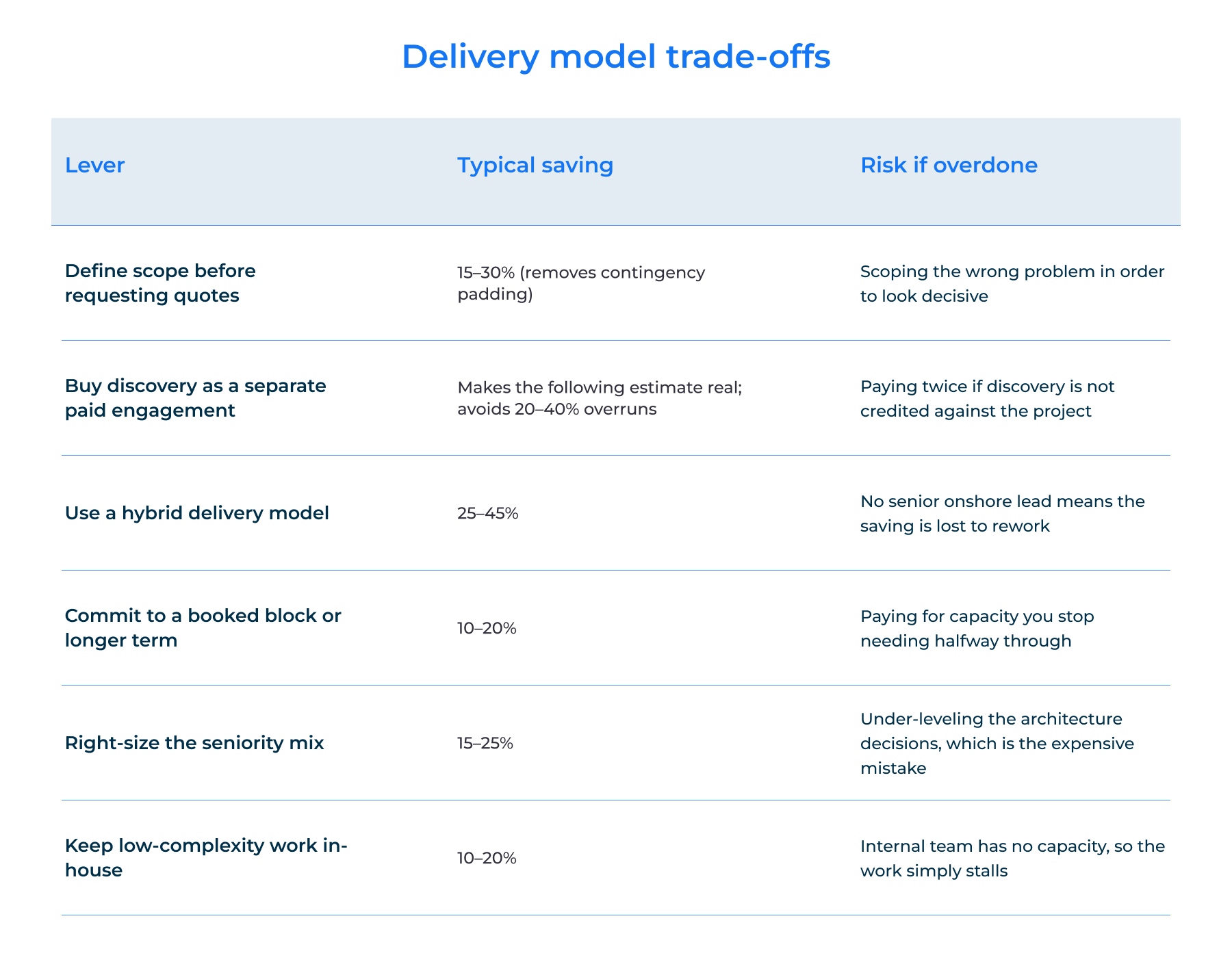
Define scope before you request quotes
Firms add contingency to proposals for work they can't see. Capture the detail in a problem description, the systems to be reviewed, the decisions to be made, and what done looks like. A single page will do.
Buy discovery as a separate paid engagement
Send the same brief to every bidder, and you will get comparable IT consulting pricing. A two-to-four-week discovery turns guesses into a real estimate. It costs money up front but prevents the larger overrun later. Negotiate one condition before you start: the discovery fee is credited against the main project if you proceed with the same firm. Otherwise, you're paying twice.
Use a hybrid delivery model
Keep senior people onshore for discovery, architecture, and sign-off. Move the long delivery phase to a nearshore team. That's where most hours sit, so the savings compound. It only works with a named senior lead who owns quality across both teams. Without one, rework eats the difference.
Commit to volume in exchange for a rate reduction
A booked block of days or a multi-month retainer gives the firm predictable revenue. In return, ask for 10–20% off the standard day rate. Keep an exit clause. If your priorities change halfway through, you don't want to keep paying for capacity nobody is using.
Right-size the seniority mix
Not every task needs a principal. Documentation, data gathering, and testing can go to mid-level or junior staff. That lowers the blended rate. Don't push it too far, though. Under-leveling architecture decisions is the mistake that costs the most to fix. You can optimize your IT outsourcing cost further by reviewing the mix every quarter.
Keep low-complexity work in-house
Password resets, license admin, basic reporting, and routine patching rarely need outside IT consultants. Your own team can take them on, which trims the hours you buy. Check capacity honestly first. If your people are already stretched, the work doesn't get cheaper. It just stops.
The cheapest bid becomes the expensive one in three cases. Work with compliance exposure, where a missed control means a fine. Migrations with a rollback risk, where a failed cutover costs more than the whole engagement. And any recommendation an auditor or board will rely on. There, low IT consulting fees buy you the liability.
How Intellectsoft Prices IT Consulting Engagements
We don't publish a rate card. A single number would tell you less than the rest of this guide already does, because your price depends on scope, seniority mix, and where the work runs. Instead, we price each engagement against a defined plan.
That plan follows six stages:
- IT discovery and assessment. An audit of your current infrastructure, systems, and risks.
- Business alignment workshop. Working sessions that tie technical gaps to business outcomes.
- Strategy and roadmap design. A multi-year roadmap with budget modeling and build, buy, or partner options.
- Architecture and solution planning. Target architecture and the decisions behind it.
- Implementation and delivery. Execution with sprint-level reporting.
- Optimization and ongoing advisory. Regular technology reviews after launch.
You can buy this as project-based consulting, with a fixed scope and a fixed price. Or you can take it as a retainer, when you need ongoing advisory and architecture oversight.
Our IT consulting services have been providing high-class solutions since 2007. Throughout the years, we have managed to deliver over 600 solutions, build a team of 250+ IT consultants and engineers, and work with 35 different Fortune 1000 clients. Our offices are distributed across nine countries to offer services in the US, European, Latin American, and Asia-Pacific regions. For UK and EU buyers, it means a team a few hours from London. Senior leads can sit onshore while delivery runs in the region that fits your budget.
Want to see where your project lands against the consulting rates in this guide? Book a free consultation. We'll come back with a scoped estimate within three to five days, not a list price.
FAQ
What is the average IT consultant hourly rate in 2026?
For firm-delivered work in the US, expect roughly $100–$300 an hour, with specialists in AI, cybersecurity, and ERP billing $300 or more. Clutch places the typical US provider at $100–$149. IT consultant rates for independent contractors run lower, often $50–$150. Seniority moves the rate more than anything else in the contract.
How much do IT consultants charge per hour in the UK?
Most UK firms quote day rates. Hourly equivalents run about £60–£250, and top-tier firms charge more. Independent contractors offer cheaper rates, says IT Jobs Watch – it put the median IT consultant contract at £500 a day, roughly £67 an hour. Before comparing quotes, you should always check whether VAT is included and whether IR35 applies.
Hourly, day rate, fixed price or retainer — which is cheapest?
None is cheapest by default. Hourly suits short, undefined work but has no ceiling. Day rates suit workshops and audits. Fixed price costs more up front because of contingency, yet often less in total for well-defined deliverables. Retainers work for ongoing advisory. The cheapest option is choosing the model that matches the clarity of your scopes.
Why do IT consulting rates differ so much between countries?
Local salaries, office space costs, and demand set consulting rates. A US or UK senior consultant costs more to employ than one in Poland or Brazil. Time-zone overlap adds a premium, which is why nearshore regions price above offshore Asia. Regulation matters too. Some regulated work can't leave the jurisdiction, so buyers pay onshore consulting fees for it.
How much does a full IT consulting project cost?
Is it cheaper to hire an IT consultant or an in-house IT manager?
It depends on what you need. For reference, the BLS put the median US IT manager salary at $175,140 in 2025 — and that's before benefits or hiring costs. A consultant costs more per hour, but you only pay for the hours you use. The in-house vs. outsourcing choice usually comes down to the kind of work and whether you'll need those specialists year-round.
How can you tell if an IT consulting quote is fair?
Compare three things, not just the rate. First, the seniority mix: who is named, and for how many days. Second, what's included and what's billed on top. Third, how scope changes are priced. A fair quote shows all three clearly. If two bids differ by 2×, the gap usually sits in staffing or scope.